
Residential Visitation
Visitation Policy & Procedure
Bishop Grady Villas (Assisted Living Facility)
Magnify of Central Florida
1. Scope
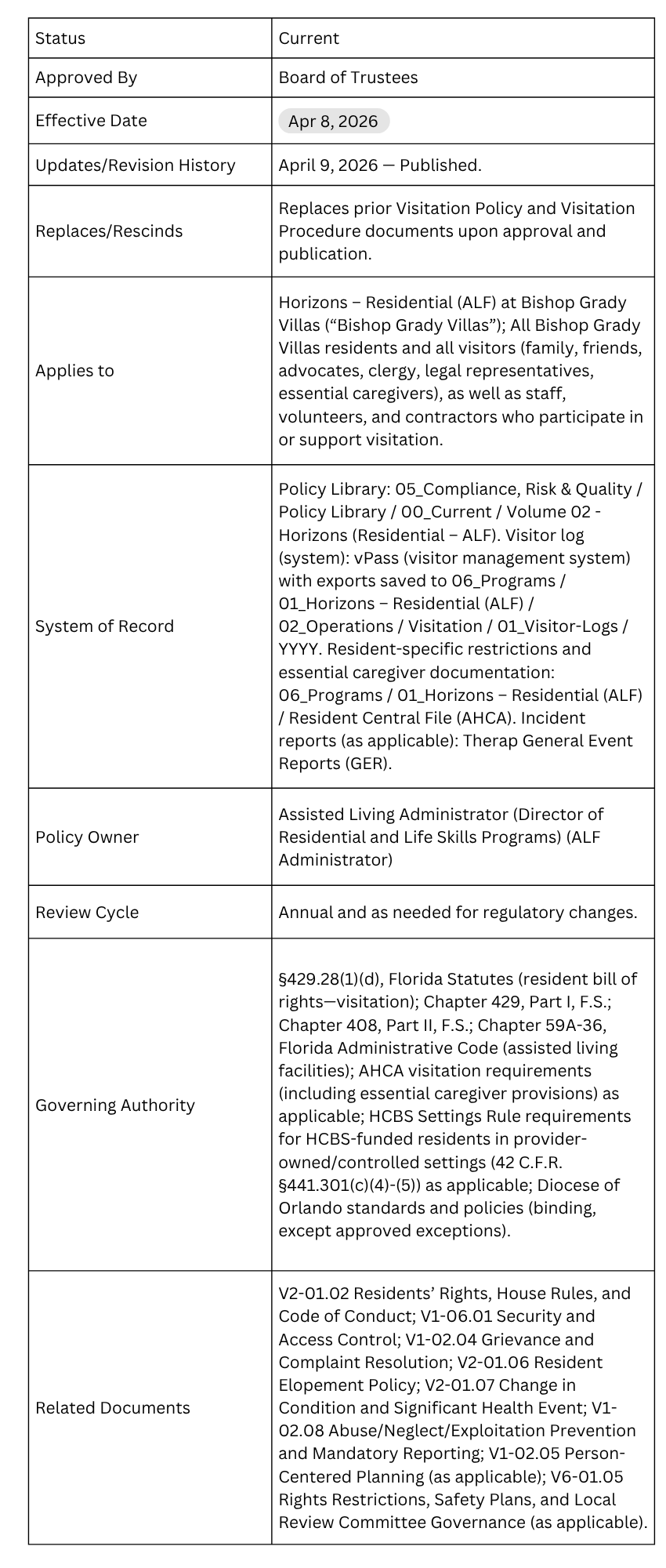
Bishop Grady Villas (“Bishop Grady Villas”) is Magnify of Central Florida’s licensed Assisted Living Facility and is operated as the Horizons – Residential (ALF) program. In AHCA’s licensure system, the facility is listed as “Bishop Grady Villas.”
This policy governs resident visitation and private communication at Bishop Grady Villas (“Bishop Grady Villas”), including routine operations, emergencies, and periods of increased communicable disease activity.
This policy applies to all residents and all visitors, including family, friends, advocates, clergy, legal representatives, and designated essential caregivers.
2. Purpose and Policy Statement
Bishop Grady Villas must support each resident’s right to visitation and unrestricted private communication while maintaining safety, privacy, and infection prevention practices. Any limitations on visitation must be reasonable, based on objective safety needs, and implemented in a manner that preserves resident rights.
Resident preference is paramount. Residents may receive visitors of their choosing, and may also restrict specific visitors by name.
3. Definitions
Essential Caregiver: A person designated by the resident (or resident representative) as an essential caregiver pursuant to applicable Florida law and facility procedures.
Visitor: Any non-resident person entering the facility to see a resident, including family/friends, clergy, advocates, service providers, and essential caregivers.
Restricted Visitation: A limitation on a specific visitor(s) requested by the resident/resident representative or implemented by the facility for objective safety reasons consistent with resident rights and due process.
Screening: A process to identify potential infection risk (e.g., symptom questions) prior to entry when indicated by facility infection prevention practices.
4. Roles and Responsibilities
· Assisted Living Administrator (Director of Residential and Life Skills Programs) must: maintain and implement this visitation policy; ensure staff follow sign-in/sign-out procedures; ensure resident restrictions are documented and honored; and ensure visitation is preserved during emergencies to the extent required.
· Direct Support Professionals must: facilitate visitation consistent with resident choice and privacy; provide visitor education as needed; and document restrictions/incidents as required.
· Residents/Resident Representatives may: designate essential caregivers, request restrictions for specific visitors, and provide preferences for visit location and privacy.
5. Policy Requirements / Procedures
5.1 Minimum visiting hours and private communication
Residents have the right to unrestricted private communication, including visiting with any person of their choice, at any time between the hours of 9:00 a.m. and 9:00 p.m. at a minimum, consistent with section 429.28(1)(d), Florida Statutes. For clarity, Bishop Grady Villas’ staffed/standard visiting hours are 9:00 a.m.–9:00 p.m. (front desk staffed; routine sign‑in). These staffed hours are not intended to limit resident rights: residents may receive resident‑authorized visitors outside staffed hours through the after‑hours access process in §5.4, subject only to reasonable safety, security, and infection‑prevention controls. Residents must also have access to a telephone and other means of private communication consistent with applicable requirements.
5.2 Number of visitors and length of visits
During routine operations, Bishop Grady Villas does not set a fixed maximum number of visitors per resident and does not impose a fixed maximum length of visit. Visits must be conducted in a manner that respects resident privacy and the rights of roommates and other residents, and that maintains safety, security, and normal facility operations. Quiet hours are 9:00 p.m.–9:00 a.m.; quiet hours address noise and disruptive behavior, not resident choice to have a visitor present.
During emergencies or communicable disease outbreaks, Bishop Grady Villas may implement temporary, reasonable limits on visitor flow or visit location to support screening, monitoring, and infection prevention, provided that resident rights are preserved and essential caregiver access is maintained as required. Any emergency-related visitation limitation must be based on current guidance, be time-limited, be no more stringent than requirements for staff performing comparable duties, and preserve essential caregiver access as applicable.
5.3 Resident choice and restriction of specific visitors
A resident (or resident representative, as applicable) may restrict access to specific visitors by submitting a written request to the Administrator. The restriction must be documented in the resident record and communicated to staff who support visitation.
Bishop Grady Villas may also restrict a visitor for objective safety reasons (e.g., threatening behavior, contraband, active abuse/harassment), with documentation and notice to the resident/resident representative as appropriate.
5.4 Visitor sign-in / sign-out and identification
· All visitors must sign in immediately upon arrival and sign out upon departure using the facility’s visitor management process (e.g., vPass).
· Visitors must follow staff direction regarding approved visit locations, resident privacy preferences, and safety rules.
· When available, visitors must display a visitor badge and follow any site-specific routing instructions (e.g., designated entrances after hours).
· All visitors must comply with behavior expectations, including respecting resident privacy, maintaining quiet during quiet hours, and following staff instructions related to safety and infection prevention.
· After-hours (outside the staffed/standard visiting hours) entry is controlled through secured access. Visitors may enter when the resident requests or authorizes access (e.g., call box, phone call to resident/unit, or staff-assisted entry), and staff may verify authorization as needed.
5.5 Location of visits and privacy
Visits may occur in a resident’s room or other designated areas consistent with resident preference and privacy. The facility must not monitor or supervise visitation except as requested by the resident or when necessary to maintain safety.
5.6 Infection prevention, screening, and PPE
Visitor-related infection control measures may be adjusted based on communicable disease activity and public health guidance. Measures must not be more stringent than those required of staff performing comparable duties.
· Visitor education may be provided through signage, written instructions, and/or staff instruction.
· When indicated, visitors may be screened prior to entry (e.g., symptom/exposure questions). Visitors who do not pass screening may be denied entry, but alternative contact (phone/video) should be offered.
· When PPE is indicated by facility infection prevention practices, visitors may be required to use appropriate PPE.
5.7 Essential caregiver visitation
Residents may designate an essential caregiver consistent with Florida law and facility procedures. Essential caregivers must follow facility safety rules, sign-in/sign-out procedures, and infection prevention expectations.
The facility may restrict an essential caregiver only for objective safety reasons and must document the basis for any restriction and notify the resident/resident representative as appropriate.
5.8 Minor visitors and Safe Environment requirements
· Minor visitors must be supervised by their parent/guardian or responsible adult at all times while on campus.
· Any organized group visits involving minors must be coordinated in advance with the Administrator and must comply with Diocese Safe Environment expectations and supervision requirements.
5.9 Policy availability
This visitation policy must be made easily accessible to residents and visitors. When the facility maintains a public website, the current visitation policy should be accessible from the homepage within 24 hours after establishment or revision, consistent with applicable requirements.
The facility must provide this policy to AHCA as required for licensure, renewal, and change of ownership processes.
5.10 Enforcement and suspension of visitation
When a visitor violates facility rules or threatens resident/staff safety, staff must immediately intervene, may require the visitor to leave, and must notify the Administrator. Law enforcement may be contacted as appropriate.
Any visitation restriction must be documented (reason, duration, conditions for reinstatement) and retained in the resident record when resident-specific.
5.11 Overnight guests
To protect resident safety, privacy, and licensure/occupancy requirements, non-resident overnight stays are not part of routine visitation and are generally not permitted. An “overnight guest” means a visitor who remains on campus during overnight hours (typically 12:00 a.m.–6:00 a.m.) or who sleeps in resident space. If a resident requests an overnight guest for a specific, time-limited reason (e.g., end-of-life support, transition support, or other individual need), the Assisted Living Administrator may approve an exception with documented conditions (e.g., roommate consent where applicable, location limits, and safety rules). For residents receiving HCBS-funded services, any provider-imposed restriction or denial of a resident-requested overnight guest must be supported by an assessed need and documented and reviewed through the person-centered planning / rights restriction process.
6. Documentation / Records
Program folder naming and numbering must follow the Folder Naming Dictionary in V1-02.03 (Documentation, Service Records, Billing & Claims Compliance), Section 6.1.
· Visitor log records (electronic system) and periodic exports as required for auditability.
· Essential caregiver designation and acknowledgement forms (resident record).
· Written resident/representative restrictions for specific visitors (resident record).
· Communications/notices related to restricted visitation.
· Incident reports (Therap GER) when visitation-related incidents occur.
Records retention must follow Records Management and Retention requirements and must be sufficient to support AHCA inspection and incident review needs.
7. Training and Communication
Staff must be trained on this visitation policy on hire/role change and at least annually. Training must include: (1) resident rights and the minimum visiting hours required by section 429.28(1)(d), F.S.; (2) the distinction between staffed/standard visiting hours and resident-authorized after-hours visitation; (3) after-hours access controls that preserve resident choice (secure entry, resident authorization, staff assist); (4) visitor sign-in/sign-out, identification/badging, and behavior expectations (including quiet hours); (5) the distinction between a resident’s choice to restrict a specific visitor (documented preference) versus a provider-imposed restriction (which, for HCBS-funded residents, requires person-centered plan modification documentation and review); and (6) the overnight guest request/exception process.
Training completion must be documented in the Training Proof repository and/or personnel file consistent with training requirements.
8. Compliance, Monitoring, and Corrective Action
The Assisted Living Administrator must periodically review visitor logs, investigate visitation-related complaints, and review incident trends. Findings must be addressed through coaching, retraining, process updates, and CAPA as appropriate.
9. References (Optional)
· Section 408.823, Florida Statutes (visitation policies and procedures).
· Section 429.28(1)(d), Florida Statutes (private communication/visitation right as referenced by ALF standards).
· Rule 59A-36, Florida Administrative Code (assisted living facility requirements).
· CMS, "PCSP in HCBS: Individual Rights and Modifications of the Settings Requirements for Provider-Owned or Controlled Settings" (guidance; examples of impermissible blanket visitor restrictions).
· 42 C.F.R. §441.301(c)(4)-(5) (HCBS Settings Rule—individual rights and permissible modifications).